
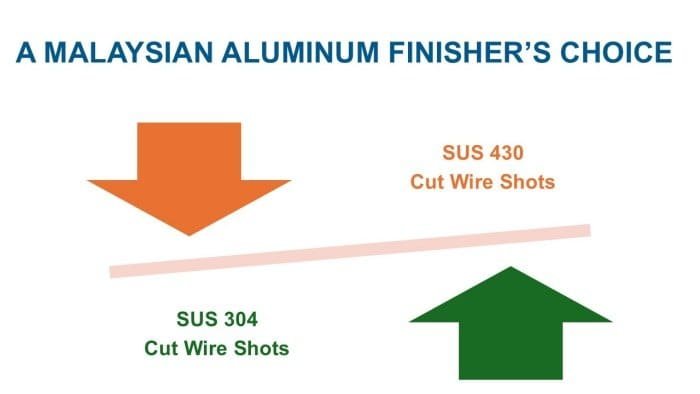
When it comes to blasting aluminum parts, many manufacturers insist on using 304 stainless steel cut wire shot. The logic sounds reasonable: 304 is a “high-grade” stainless with strong corrosion resistance, so it is assumed to be the safest and most reliable choice.
But in many real-world applications, this choice is technically conservative and economically inefficient.
In this case study, we look at a Malaysian company processing aluminum components that originally used 0.4 mm 304 stainless cut wire shot in their blasting machine. After a detailed discussion of their process and performance requirements, we proposed switching to 0.4 mm 430 stainless cut wire shot instead.
The result: the customer kept all the benefits of stainless media — no rust staining, clean surface, stable blasting — while significantly reducing their abrasive cost per kilogram and per part.
Not all aluminum blasting applications require 304 stainless shot. In many cases, 430 stainless cut wire provides equivalent technical performance at a lower media cost.
Who Was the Customer and What Were They Doing?
The customer is a Malaysian manufacturer of aluminum components, supplying parts to the building, electrical and general industrial sectors. Their products include:
- Aluminum brackets and housings
- Small structural profiles
- Various machined and cast aluminum parts
Most of these components are:
- Blasted to remove light oxidation and machining marks
- Then powder coated or painted for appearance and protection
The company operates multiple blasting machinesms, both automated and manual, running five to six days per week. On a typical day, they process:
- Several thousand small to medium-sized parts
- With a strong focus on consistent surface appearance and coating adhesion
To avoid any risk of iron contamination or rust stains on aluminum, the company had standardized on 0.4 mm 304 stainless cut wire shot as the only abrasive used in all machines.
However, they began to feel increasing cost pressure from:
- Rising stainless steel prices
- Higher operating costs per part
- The need to stay competitive against regional suppliers
The customer had a mature process with good quality, but abrasive media cost had become a growing concern.
Why Was the Customer Using 304 Stainless Cut Wire?
When we first spoke with the customer, they were very clear: their blasting media “must be 304 stainless, 0.4 mm cut wire shot.”
We asked why. Their reasons were logical:
- Concern about rust stains on aluminum
- They wanted to completely avoid any risk of brown or red rust marks on finished parts.
- Past experience with carbon steel media had left them with a strong preference for stainless.
- Original equipment supplier recommendation
- When they purchased their first blasting machine, the equipment supplier recommended 304 stainless cut wire as a “universal solution” for all aluminum parts.
- The specification was then copied into internal procedures and never revisited.
- Perception of 304 as “the safest stainless”
- Many engineers and managers associate 304 with high corrosion resistance and premium quality.
- In their minds, using 304 eliminated questions and internal debate—it was simply “the best.”
What they did not fully consider was that:
- Their blasting media operates inside closed machines, in a controlled environment.
- The key requirement is that the media does not rust easily and does not leave rust stains on the parts, under their specific process conditions.
- The parts themselves are fully coated afterward, and are used mostly in indoor or mildly corrosive environments.
The choice of 304 stainless was driven more by habit and perceived safety than by a detailed, application-specific evaluation.
What Did We Learn About Their Actual Process?
Before suggesting any change, we took time to understand the customer’s real operating conditions.
Substrate and finishing process
- Substrate: mainly aluminum alloys (e.g. 6xxx series), used for brackets, housings and profiles
- Pre-blast condition:
- Light oxidation from storage
- Machining marks or minor casting texture
- Traces of lubricants or fingerprints
- Post-blast operations:
- Cleaning and inspection
- Powder coating or liquid painting, followed by curing
- Service environment:
- Mostly indoor or sheltered applications
- Some standard outdoor exposure, but no highly aggressive marine or chemical environments
Blasting equipment and media management
- The customer used closed blasting machines with efficient media recovery and separation.
- The environment inside the machines was dry and controlled, with regular maintenance.
- Media was kept relatively clean and dry, with no deliberate exposure to moisture.
Real technical requirements for the media
From the discussion, we summarized their critical requirements as:
- The blasting media must not cause rust stains on aluminum parts.
- It must deliver a consistent, moderately fine surface profile suitable for powder coating and painting.
- It must be dimensionally stable (0.4 mm equivalent size) to fit their established process window.
- It must have reasonable durability to keep consumption under control.
Once mapped, these requirements did not automatically demand the use of 304 stainless. What they clearly required was:
- A reliable stainless media with adequate corrosion resistance under their process conditions.
- But not necessarily the highest-alloy, most expensive stainless grade.
The customer’s process needed stainless media, but it did not strictly require 304. This opened the door to evaluating more cost-effective grades.
Why Did We Propose 430 Stainless Cut Wire Shot 0.4 mm?
After reviewing their process, we proposed they test 0.4 mm 430 stainless cut wire shot as an alternative to their existing 304 media.
304 vs 430: what’s the difference for blasting media?
- 304 stainless steel
- Austenitic stainless, containing nickel
- Very good corrosion resistance in a wide range of environments
- More expensive due to higher alloying content (especially nickel)
- 430 stainless steel
- Ferritic stainless, nickel-free or with very low Ni content
- Good corrosion resistance in mild environments (indoor, mild outdoor, low chlorides)
- Lower raw material cost compared to 304
For blasting media inside a dry, controlled machine, the essential requirement is that the shot:
- Does not readily rust inside the machine
- Does not leave rust stains on parts handled under normal production conditions
- Maintains good mechanical integrity and shape during its useful life
I
n many such cases, 430 stainless is more than sufficient. It still qualifies as stainless steel, but its lower nickel content reduces the media cost significantly.
Matching size and performance
To ensure a smooth transition, our proposal kept the key process parameter constant:
- Media size: 0.4 mm equivalent (matched to their original 304 cut wire size)
- Media type: conditioned stainless cut wire shot, with controlled shape and hardness
- Target roughness: comparable to their existing process window
The idea was to change grade (304 → 430), not to disrupt their entire blasting profile.
Risk considerations
We openly discussed risk with the customer:
- Under their dry, closed-machine conditions, with proper housekeeping, 430 stainless shot would not be expected to rust.
- The parts are fully coated afterward, so any minor difference in corrosion resistance between 304 and 430 on microscopic residues has minimal practical impact.
- For special jobs with unusually harsh environments, they could still keep 304 as a backup option if desired.
430 stainless cut wire shot offered the same functional benefits as 304 in this specific process, while significantly reducing the media cost per kilogram.
How Did We Validate 430 Stainless Shot in Practice?
To eliminate doubt, we agreed on a step-by-step trial comparing 304 and 430 under real production conditions.
Trial setup
The customer ran two comparative tests:
- Media A – Existing: 0.4 mm 304 stainless cut wire shot
- Media B – Proposed: 0.4 mm 430 stainless cut wire shot
For each media type, they monitored:
- Surface cleanliness and appearance of blasted aluminum parts
- Surface profile (Ra) in selected areas
- Coating adhesion and visual quality after powder coating / painting
- Any signs of staining or discoloration during normal handling
- Media consumption and replacement rate over a defined period
Evaluation criteria
The evaluation focused on four practical questions:
- Is the blasted surface identical or equivalent?
- No scratches, no excessive roughness, no visible defects
- Does coating performance remain stable?
- Good flow and leveling
- No adhesion failures in cross-cut tests
- No increase in coating defects
- Is there any evidence of rust staining or corrosion issues?
- On blasted parts before coating
- On coated parts during short-term storage
- What is the impact on media and operating cost?
- Comparative media price
- Estimated cost per part based on consumption
Trial outcomes
The comparative trial showed:
- Surface appearance and profile:
- Parts blasted with 430 stainless shot looked indistinguishable from those blasted with 304 in normal visual inspection.
- Measured surface roughness remained within the same acceptable range.
- Coating performance:
- Powder-coated and painted parts passed all internal adhesion and appearance criteria in both cases.
- No difference in defect rate was observed between 304 and 430 trials.
- Corrosion / staining:
- Under the customer’s normal handling conditions, no rust staining or abnormal discoloration was observed on parts blasted with 430 stainless before coating.
- Coated parts also showed no issues during short-term storage and initial field use.
- Cost per part:
- Due to the lower alloy content and raw material cost of 430 stainless, the media price per kilogram was significantly lower than 304.
- With similar consumption rate and durability, the abrasive cost per blasted part decreased accordingly.
The tests confirmed that 430 stainless cut wire shot could deliver the same technical performance as 304 in this application, with a clear cost advantage.
What Benefits Did the Malaysian Company Achieve?
Based on the successful trials, the customer decided to standardize 430 stainless cut wire shot 0.4 mm as their main blasting media for aluminum parts.
Technical continuity
From a technical standpoint:
- Blasting processes required no major parameter changes, apart from routine fine-tuning.
- Operators reported no noticeable difference in handling or results between 304 and 430 media.
- The customer’s clients did not perceive any change in surface quality or coating performance.
In other words, the change was technically seamless.
Cost reduction
From a cost perspective:
- The media unit price for 430 stainless was lower than for 304.
- With comparable media life and consumption, the annual abrasive spend was reduced.
- Given the company’s throughput, the savings reached a meaningful level on a yearly basis, helping offset other rising costs in energy and labor.
Strategic flexibility
The change also gave the customer more flexibility:
- 430 stainless became their standard media for most aluminum jobs.
- For very special projects with extreme corrosion or client-specific specifications, they kept the option to use 304 if truly required.
- Internally, they updated their procedures to differentiate between “must-have 304” cases and “430 is sufficient” cases, instead of using 304 for everything by default.
By switching from 304 to 430 stainless cut wire shot, the customer kept all the essential benefits of stainless media while turning abrasive selection into a more rational, cost-conscious decision.
What Can Other Aluminum Finishers Learn from This Case?
This Malaysian case does not mean that 304 stainless shot is never necessary. However, it shows that using 304 by habit can lock a company into higher media costs than needed.
When 304 stainless is still justified
304 stainless abrasives may remain the preferred choice when:
- Parts or media are exposed to more aggressive environments (e.g. frequent moisture, chlorides, harsh chemicals) even before coating.
- The customer’s or end-user’s specifications explicitly require 304 or austenitic stainless media.
- There is a strong need for maximum corrosion resistance of the media itself in storage and operation.
When 430 stainless is a strong alternative
430 stainless cut wire shot can be an excellent choice when:
- Blasting takes place in dry, closed machines with proper housekeeping.
- Parts are fully coated after blasting and operate in indoor or mild outdoor environments.
- The key requirements are:
- No rust staining
- Consistent surface profile for coating
- Good durability and recyclability
- The company faces pressure to control operating costs in a competitive market.
For many aluminum blasting operations, 430 stainless media can deliver the same functional results as 304, at a lower cost and with no sacrifice in quality when the process is properly controlled.
Conclusion: Choosing the Right Stainless Grade, Not Just the Most Expensive One
In this Malaysian case, the customer’s long-standing use of 304 stainless cut wire shot 0.4 mm was understandable—but not optimized.
By stepping back and asking a few key questions about:
- The real process conditions (dry, closed machines)
- The post-blasting coating system
- The service environment of the finished parts
It became clear that 430 stainless cut wire shot 0.4 mm could meet all technical requirements while reducing abrasive media cost.
At BH, our goal is not simply to sell abrasives, but to help customers choose the right abrasive grade for their applications—whether that is carbon steel, stainless steel, or other media. Sometimes the right solution is a higher grade; in other cases, as this story shows, a more economical grade such as 430 stainless can deliver full performance at a lower cost.
If you are currently using 304 stainless abrasives for aluminum blasting and would like to review whether a 430 stainless alternative could be suitable, you are very welcome to share your process details with us. We are glad to evaluate your application and suggest a solution that balances quality, reliability and cost.