
1. Customer Background
An Italian steel pipe manufacturer approached us for support with their continuous blasting and descaling line.
They produce carbon steel pipes by continuous galvanizing, using hot-rolled carbon steel coil strip as feed material. Before galvanizing, the mill runs the strip through a continuous blasting machine to remove scale and prepare the surface.
Key process parameters:
- Product: hot-rolled carbon steel coil strip for galvanizing steel pipes
- Coil strip width: 65–200 mm
- Thickness: 1.5–3.2 mm
- Line speed: 100 m/min
- Blasting machine: 3 blasting wheels, up to 3,000 RPM
- Required cleanliness: SA 3 / SSPC-SP5 “white metal”, bright surface
- Target surface profile: 15–25 μm
The customer had been using high-carbon cast steel shot S110 as the blasting media in this line.
2. Challenges with the Existing Cast Steel Shot S110
Over time, the customer began to face several challenges with the conventional cast steel shot:
Surface profile and appearance not fully optimized
- In some production runs, the surface profile tended to be at the upper end or slightly above the 15–25 μm window.
- For thin strip (1.5–2.0 mm), the impact of high-carbon shots at high wheel speed occasionally led to a more aggressive profile and less “bright” appearance than desired.
High dust load and short filter life
- The high-carbon shots were more prone to brittle fracture under high-intensity, high-speed blasting.
- This generated a significant amount of fines and dust, increasing:
- Load on the dust collection system
- Frequency of filter cartridge replacement
- Housekeeping work around the line
Abrasive consumption and overall operating cost
- Due to higher breakage, the effective life of each kilogram of abrasive was limited.
- The customer observed relatively high abrasive consumption per ton of processed coil, pushing up the total blasting cost.
Risk to thin strip and edge quality
- Although there were no catastrophic failures, the customer was concerned about the long-term effect of aggressive impact on:
- Thin strip sections
- Edge integrity
- They wanted a more controlled, consistent surface preparation, especially as production volumes increased.
3. Our Diagnostic Approach
Instead of simply offering a different product, our team first worked to understand the full process context.
We reviewed the customer’s application based on:
- Material & geometry
- Hot-rolled carbon steel coil strip
- Width: 65–200 mm
- Thickness: 1.5–3.2 mm
- Surface requirement
- Cleanliness: equivalent to SA 3 / SSPC-SP5, bright, fully descaled surface
- Target surface profile: 15–25 μm, suitable for continuous galvanizing
- Process parameters
- Line speed: 100 m/min
- Three blasting wheels up to 3,000 RPM
- Existing media: high-carbon cast steel shot S110
We then collected and discussed:
- Typical hardness range of the existing cast steel shot
- Estimated abrasive consumption (kg per ton of coil)
- Dust load and filter replacement frequency
- Measured surface profile distribution across multiple coils
- Operators’ feedback on surface appearance and line stability
Based on this review, it became clear that:
- The cleanliness level SA 3 / SP5 was achievable,
- But there was room for improvement in:
- Surface profile control
- Dust generation
- Abrasive consumption and overall cost.
4. Proposed Solution: Low-Carbon Steel Shot S110
After the technical evaluation, we recommended switching from the existing high-carbon cast steel shot to Low-Carbon Steel Shot S110.
Key characteristics of our Low-Carbon Steel Shot S110:
- S110 size range to maintain the required profile for strip thickness 1.5–3.2 mm
- Slightly lower hardness compared with typical high-carbon cast shot
- From a harder range (e.g. HRC around 40±5)
- To a moderate hardness window (approx. HRC low–mid 30s)
- Higher toughness and lower breakage rate
- Reduced tendency to fracture under repeated impact
- More stable working mix over time
- Optimized for applications where:
- The substrate is relatively thin, and
- A bright, controlled surface profile is critical for downstream coating or galvanizing.
In other words, the low-carbon steel shot S110 offers a more “forgiving” impact on the steel surface while still achieving the required SA 3 / SP5 cleanliness and the 15–25 μm profile window.
5. Implementation and Process Adjustments
To ensure that cleaning efficiency remained at least as good as before, we did not only change the abrasive. We also supported the customer in fine-tuning the process settings.
Together with the production team, the following steps were taken:
- Gradual media replacement
- The old media was gradually replaced with low-carbon steel shot S110 to build up a stable working mix.
- The customer monitored dust levels, blasting pattern and surface appearance during this transition.
- Wheel speed and feed rate check
- Blasting wheel speed remained within the existing maximum of 3,000 RPM, but small adjustments were tested to optimise:
- Impact energy
- Coverage uniformity
- Line speed of 100 m/min was initially maintained, then adjusted slightly during optimization trials if required.
- Blasting wheel speed remained within the existing maximum of 3,000 RPM, but small adjustments were tested to optimise:
- Control of the working mix
- Sieve analysis of the abrasive was used to maintain a balanced particle size distribution, ensuring:
- Consistent surface profile
- Stable blasting efficiency
- Sieve analysis of the abrasive was used to maintain a balanced particle size distribution, ensuring:
Through these adjustments, the customer was able to maintain their SA 3 / SP5 cleanliness requirement while benefiting from the different behaviour of low-carbon steel shot.
6. Trial Results: Before vs After
After several weeks of operation with Low-Carbon Steel Shot S110, the customer summarized the results.
The figures below are indicative of the observed trends:
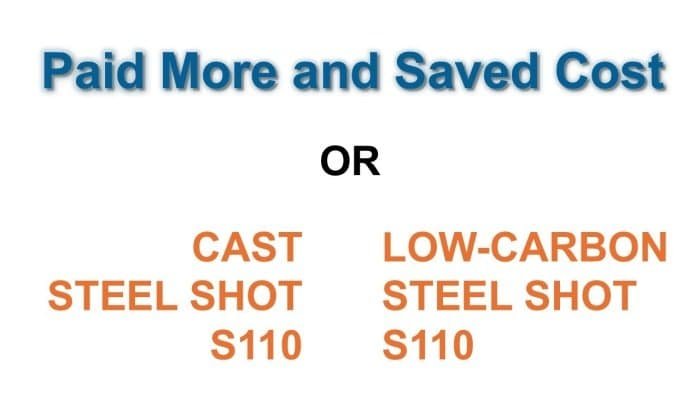
| Indicator | Before: Cast Steel Shot S110 | After: Low-Carbon Steel Shot S110 |
| Abrasive consumption per ton of coil | 100% (baseline) | ≈ 85–90% of baseline |
| Dust load / filter change frequency | High / frequent | Noticeably reduced |
| Surface cleanliness | SA 3 / SP5 | SA 3 / SP5 (maintained) |
| Surface profile (target 15–25 μm) | More variation, sometimes near upper limit | More stable, concentrated within target window |
| Risk of over-aggressive impact on thin strip | Occasional concern | Significantly reduced |
| Overall operating cost (abrasive + maintenance) | 100% (baseline) | ≈ 90–95% of baseline |
In the customer’s own words, after the initial trial period they observed roughly 10–15% lower abrasive consumption, less dust, and a more consistent surface profile while keeping the same SA 3 / SP5 bright finish.
7. Customer Feedback
The feedback from the Italian steel pipe manufacturer focused on three main aspects:
- Improved working environment
- Lower dust generation led to:
- A cleaner blasting chamber
- Less stress on the dust collection system
- Longer filter life and fewer unplanned stops
- Lower dust generation led to:
- More controlled surface preparation
- The surface remained bright and fully descaled at SA 3 / SP5 level.
- The profile was more stable within the 15–25 μm target, which helped:
- Maintain good zinc adhesion in the galvanizing step
- Reduce the risk of unnecessary roughness on thinner strip
- Better overall cost efficiency
- Although the price per ton of abrasive was not dramatically different, the combination of lower consumption and reduced maintenance resulted in a measurable reduction in total blasting cost per ton of coil.
8. Conclusion: From “Which S110?” to “Which Process Is Right?”
This project was not just a change from one S110 to another. It was a process optimisation based on:
- The specific geometry and thickness of the strip
- The required cleanliness (SA 3 / SP5) and profile (15–25 μm)
- The realities of a high-speed continuous blasting line at 100 m/min.
By moving from high-carbon cast steel shot S110 to Low-Carbon Steel Shot S110, the Italian steel pipe manufacturer was able to:
- Maintain the required SA 3 / SP5 bright finish
- Keep the surface profile within the specified 15–25 μm range
- Reduce dust and improve filter life
- Lower abrasive consumption and overall operating cost
For other pipe mills, strip galvanizing lines or tube producers facing similar challenges, this case shows that:
The key question is not only “which size of steel shot should I use?”, but also
“which steel shot hardness and microstructure are best matched to my line speed, strip thickness and surface requirements?”
If you are operating a continuous blasting line for coils, pipes or profiles and would like to review whether low-carbon steel shot could improve your results, our team is ready to analyse your parameters and propose a tailored solution.